
When I first started my home staging business almost twenty years ago, there was a company called Haverhill that ran ads on HGTV about their home staging course. They advertised that if you had a flair for design, you could become a home stager and get to design beautiful spaces every day. That message lit a fire for thousands of women across North America who took home staging courses and started their own businesses. Every one offered similar services. Stagers called themselves either “occupied” or “vacant” stagers. With so few stagers in business at that time, standing out as a home stager wasn’t an issue.
Today, with tens of thousands of stagers across North America, Europe, and beyond, that sameness is becoming a real problem. If you want to stand out as a home stager these days, it takes more than getting certified or starting a business. It takes more than adding the word “luxury” in front of your services, too. It takes a willingness to think about your business differently to differentiate yourself in an increasingly competitive market.
Why Labels are not a Positioning Strategy
For years, the staging industry sorted itself into two categories: occupied or vacant. Then, luxury vacant staging became the aspirational goal, and the industry followed. It is still one of the most common positions I see stagers reach for — all competing for the same small slice of the market, often in the same city, often with nearly identical design styles and messaging.

When everyone is reaching for the same title, the only thing left to compare is price. Not expertise or a signature approach. Not the specific value one stager brings over another. Just price.
This is not a marketing problem. It is a positioning problem. And more content, more posting, and a prettier website will not fix it. In my article on the importance of thought leader content, I discuss why positioning has to come before promotion if you want to truly stand out as a home stager.
The Opportunity Most Stagers are not Seeing
Here is a number worth sitting with. Research suggests that only about 18% of sellers actually hire a stager before listing their home. That means the vast majority of the market is currently unserved — not because staging is not valuable, but because the industry has not built enough options to reach them.
Most stagers are competing hard for that same 18%. The 82% of sellers who are not hiring stagers at all rarely come up in the conversation. That gap is where real opportunity lives. And finding it requires a different kind of thinking than most staging education ever covers.

During my brand development process, I ask every client three questions. What do you love doing? What would you like to do more of? And what is no one else in your market doing? That last question is where the real work begins. It is also where stagers start to see their home staging business model differently — not as a fixed set of services they inherited from their training, but as something they actually get to design.
What Real Home Staging Differentiation Looks Like
Danielle of House of Wabi Lifestyle Designs is one of the clearest examples I can point to. When we started working together on her branding, she was committed to building a vacant home staging business because that’s what she felt she had to do. That changed, though, as we did her identity work and she realized that she didn’t want to be a stager at all. She bravely ditched the staging labels entirely and built something that did not exist in her market. Her business now offers lifestyle design services and she is developing a membership program to support her clients on an ongoing basis. She did not find her position by following what other stagers were doing. She found it by asking what she actually wanted to build and where her market had not been served.

Another branding client of mine took a completely different path. She stepped back from offering a full range of staging services and focused entirely on building a business based around delivering an exceptional staging consultation. Not a quick walk-through. A comprehensive report, a curated shopping list with product links, moodboards — a complete plan that gave sellers a designer-level result at a fraction of the cost of traditional staging. She built a solid business on that one offer because no one else in her market was doing it. Every other stager around her was still chasing the same vacant staging jobs.
These are not outliers. They are what becomes possible when a stager stops looking sideways at what everyone else is doing and starts asking what her market actually needs.
Inside the Six-Figure Stager, my business and marketing mentorship for stagers, the foundation of our work is to develop a stager’s positioning and build everything around it. Because brand positioning sits at the center of what makes a home stager’s marketing strategy work long term. The stagers who attract the right clients and stop competing on price are rarely the ones with the biggest inventories. They are the ones who identified a specific gap and built something around it. Those are the stagers who truly stand out.
Where to Start Looking for Your White Space
There is more room in this industry than most stagers have been led to believe. Senior downsizing is one of the most underserved pockets in the market right now. As a professional who specializes in working with seniors, one of the things I would recommend is to pick a different name other than that of stager. That would be a great way to differentiate yourself. Other ideas focus on developing passive income streams, such as digital guides that teach sellers to stage their own homes. Or guides and courses that teach people the basics of decluttering and organization. Consultation-only models that reach sellers who would never budget for traditional staging. These are not fringe ideas. They are real opportunities sitting in markets across North America that are largely untouched.
Your competition is useful information here, but not in the way most people use it. Look at what other stagers in your area are offering, not to copy them, but to understand what they are not doing. The gaps they leave open are opportunities that have not yet been claimed.
What do your clients ask for that no one is delivering? Which services do you love doing that your current business barely makes room for? What would you build if you were not trying to replicate what every other stager does?
Those questions will get you further than any certification, title, or trend the industry hands you.
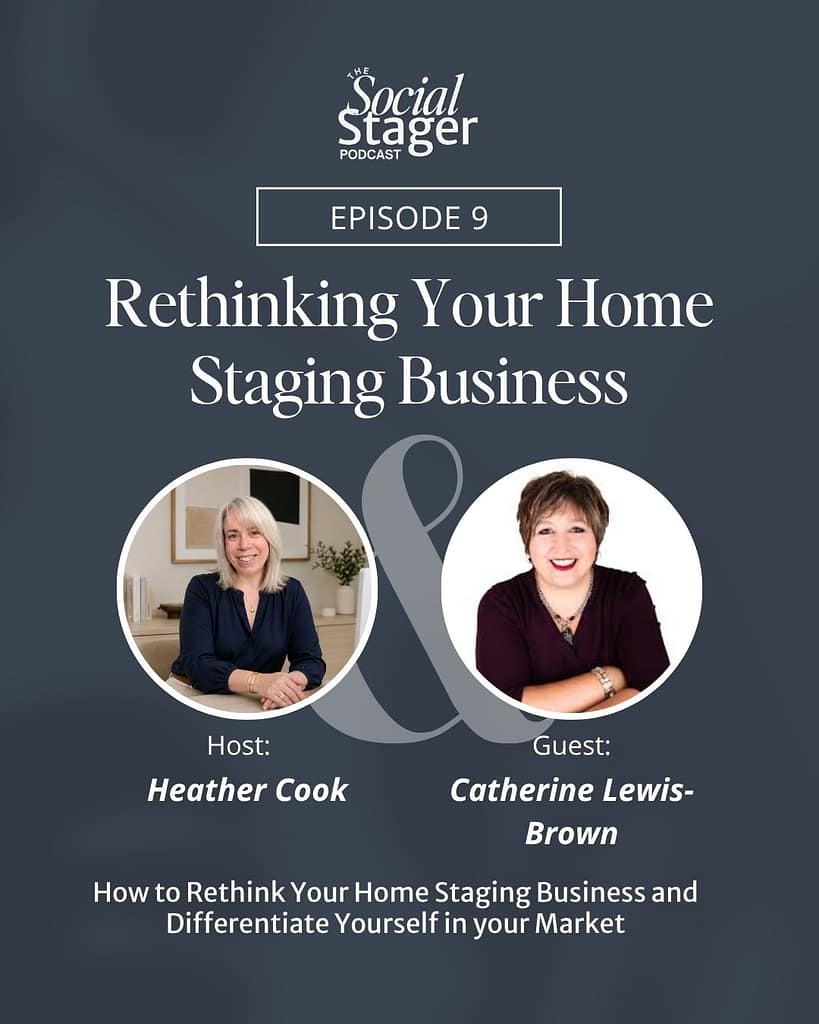
If you want to hear more of this conversation, I explored these ideas with staging coach and trainer Catherine Lewis-Brown on The Social Stager Podcast. You can listen to the full episode here.
If You Want Help Finding Your Position
Knowing that white space exists and knowing how to build a brand around it are two different things. Inside my Standout Stager Course or in my 1:1 brand development services, we work through this. From how to identify what makes your business genuinely different, how to build a home staging business model that reflects it, and how to market yourself in a way that attracts clients who are looking for what you specifically offer.
You do not have to keep competing for the same piece of the market as everyone else. There is more room out there than the industry has shown you.