



When I started my home staging business in 2008, AI didn’t exist. I didn’t have to worry about how ChatGPT or Claude would find me or how I would show up in an AI-powered search. I used other tools like blogging and Facebook posting to help build my visibility and put my business in front of new clients. Today, everything is different. Getting discovered online now means figuring out how to get found by ChatGPT and other AI search tools.
That core truth hasn’t changed. But how people search for information has changed dramatically. For home staging businesses, the shift to AI-powered search presents one of the most significant visibility challenges the industry has ever faced, because AI cannot see almost everything stagers have been taught to do to market themselves online.

To get found by ChatGPT and other AI platforms, you need to understand how these tools work. They look for what will make your business visible, and why the staging industry’s reliance on visual-first marketing for years will leave your business invisible in the search landscape that’s already here.what they look for, and why the visual-first marketing approach that the staging industry has relied on for years will leave your business invisible in the search landscape that’s already here.
Why AI Search Is a Problem Most Home Stagers Don’t Know They Have
Home stagers are, by the nature of the work, visual marketers. The industry trained itself to lead with beautiful visuals, before-and-after photos, and polished portfolio images. That approach made sense when the goal was to impress potential clients on Instagram or Pinterest. It made less sense for Google SEO, which has always required written content. And it makes almost no sense for AI-powered search.
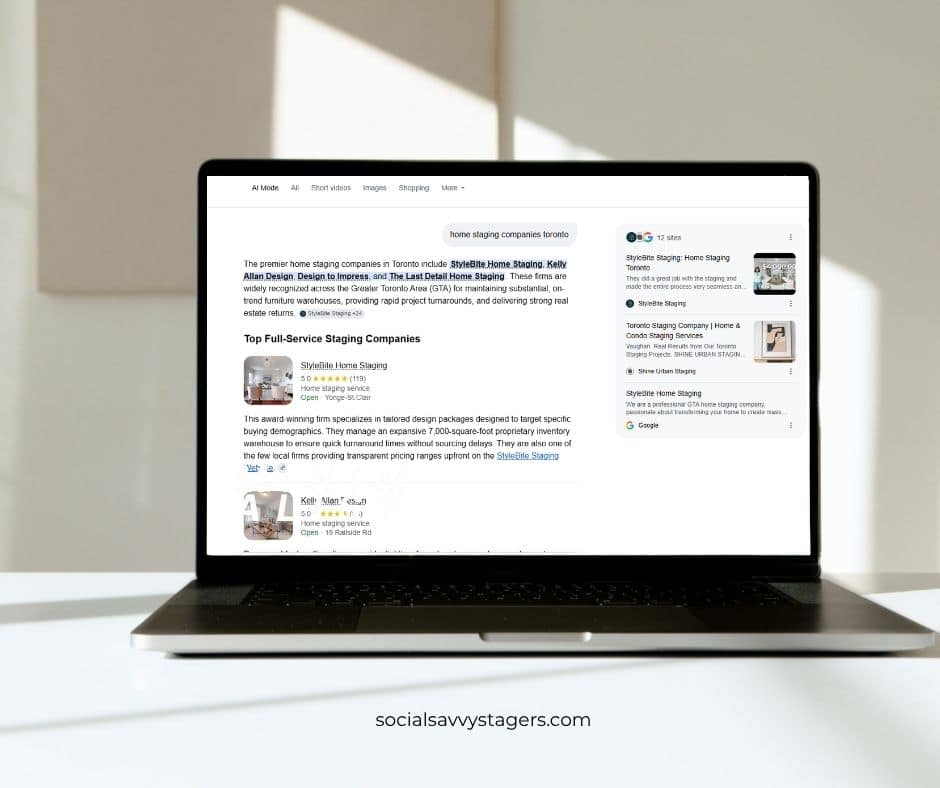
Here’s what most stagers don’t realize: AI tools like ChatGPT, Claude, Perplexity, and Google’s AI Overview cannot read an image. They can’t watch a video or pull meaning from a photo. If someone asks ChatGPT, “Who’s the best home stager in [city]?” and your entire online presence is built on photos and social media content, AI has almost nothing to work with. Your business is effectively invisible to it.
Stagers who want to get found online face a huge issue. Most stagers want to be more visible online, not less. But from what I can tell, this issue is largely unknown in the staging industry because no one (but me) is talking about it.
Beyond that, most staging websites are built for aesthetics rather than discoverability. Thin service pages. No written content or FAQs. No blog. Beautiful to look at, almost impossible for AI to evaluate. If you didn’t build your website with home staging website SEO in mind from the start, Google won’t rank you highly, and AI search tools won’t recommend you either.
The stagers who understand how to get found by ChatGPT and other AI platforms now have a real first-mover advantage in their local market. The window to get ahead of this is open. It won’t stay that way for long.
How to Get Found by ChatGPT and Other AI Tools
AI platforms don’t search the internet the way people do. They draw on structured, authoritative sources such as written content, verified business listings, and a business’s accumulated digital footprint across multiple channels. Understanding what those sources are is the starting point to help stagers get found by ChatGPT and other AI tools.
1. Your Website Needs to Make You Sound Like an Expert
Web designers build most staging websites to look pretty. The goal is usually to showcase the beautiful work you do, communicate a brand aesthetic, and give people a way to get in touch. That’s fine. But it’s not enough for AI discoverability or to get found by ChatGPT.
AI tools evaluate websites as indicators of trust and authority. What they look for is structure, written content, and specificity. Here’s what that means in practice:
- Page titles and subheadings need to match how people actually search. “Services” as a page title does nothing for AI. “Home Staging Services in [City]” gives AI something to work with. Subheadings written like real questions — “What does home staging include?” or “How much does home staging cost?” — are the kind of structured content AI tools are designed to find and surface.
- Service pages need real written descriptions. Not a one-liner. A detailed explanation of what you do, how you do it, and who it’s for. AI tools treat thin pages as low-authority sources. If your services page is mostly images with a few bullet points, it’s not registering the way you need it to.
- Every image on your website needs descriptive alt text. This is the one most stagers miss completely, and it matters enormously in a visual industry. Alt text tells both search engines and AI tools what they’re looking at by providing a written description attached to an image. “Staged living room” is not useful. “Home staging in [city]: neutral modern living room staged to attract buyers and reduce time on market” is. Every photo on your website should have alt text written with this level of specificity. When I build websites for stagers and design professionals, alt text is part of the strategic foundation — not an afterthought. Every image, every page, every keyword—you write with intent so AI tools know exactly who you are and what you do.
- FAQs and written content give AI tools something to pull from. A well-structured FAQ page that answers the real questions your clients ask — what staging costs, what the process looks like, what sellers can expect — is one of the most valuable things you can add to your website. Designers create AI tools to surface direct answers to direct questions. Give them the answers, and you’ll have a better chance of ChatGPT finding your business.
- Testimonials and case studies support trust signals. AI tools treat social proof as an indicator of reliability. Client testimonials on your website, ideally with specific outcomes mentioned, contribute to how AI evaluates your business as a credible source.
If you want to go deeper into how written content builds authority for your staging business, I wrote about the importance of thought-leader content and cover the strategy behind it in detail. The principle connects directly to what AI is looking for.
2. Your Business Listings Are Where AI Goes First for Local Recommendations
When someone asks an AI tool for a home stager recommendation in their city, the first thing that tool does is pull from structured, verified sources. Not social media. Not your portfolio. Your business listings.
This is where local SEO for home stagers matters most, and where most stagers have significant gaps. The platforms AI tools pull from most heavily for local service recommendations include:
- Google Business Profile (this is the most important one)
- Houzz
- Yelp
- LinkedIn company page
- BBB
- RESA directory
- Local business directories specific to your market
What “complete” means on these platforms is not just having a profile. It means you fully fill out your business name, address, phone number, website URL, and service description, keep them consistent across all platforms, and update them regularly. Inconsistency across platforms, even small things like abbreviated business names or slightly different service descriptions, confuses AI tools and reduces the likelihood that your business will be recommended.
Your Google Business Profile deserves specific attention because it’s one of the main sources AI uses, besides your website. Keep it claimed, verified, and fully filled out. Add photos. Update your service descriptions. Make sure your hours are current. This is the single highest-impact, lowest-effort action most stagers can take right now to improve their AI discoverability.
3. Home Staging Blog Content Is No Longer Optional
I said it when I launched my staging business in 2008, and I’ll say it again in 2026: written content is the most powerful marketing tool most stagers aren’t using. The difference is that in 2008, a blog helped Google find you. Today, home staging blog content is also how AI platforms evaluate whether you’re a credible, authoritative source worth recommending.
Most of a stager’s marketing content — the reels, the carousels, the photo posts — exists in a format AI simply cannot process. Without a written transcript, text overlay, or accompanying caption that tells the full story, that content contributes nothing to how AI evaluates your expertise or decides whether to recommend your business.
AI tools are built to find and surface written blog content that answers the questions your clients are actually asking. Think about the questions that come up repeatedly in your consultations and client conversations. Or the questions you see asked on sites like AnswerThePublic. Stagers looking at those questions as their content roadmap will help them get found by ChatGPT and other AI tools.
A blog post that answers “how much does home staging cost in [city]?” gets surfaced when someone asks that exact question to an AI tool. Social media content with the same information, in the absence of substantial written copy, doesn’t register the same way.
You don’t need to write academic articles or publish every week. A well-structured post of 800 to 1,000 words that answers one real question, with clear subheadings and plain language, is enough. The key is to do it consistently over time and structure it so that AI can find it. I go into more detail on how to do that strategically in my latest podcast episode.

4. AI Searches for Your Name, Not Just Your Business Name
Stagers want to get their business found online. Fewer think about getting people to find their name.You should want AI to find you both ways.
AI tools get asked things like “who are the top home stagers in [city]?” or “what home stager should I hire in [area]?” If your name isn’t appearing across multiple platforms with consistent attribution to staging, you won’t surface in those results. It’s not enough for your business name to appear in one or two places. AI builds a picture of authority from how many credible sources mention or reference you.

This is where getting your name and expertise into places beyond your own website pays off. Guest podcast appearances with links back to your site. Being quoted in the local press or real estate publications. Features in industry directories. Guest blog posts on relevant platforms. Each of these signals to AI tools that you are a recognized expert, not just a business with a website.
You don’t need to be everywhere. You need to be somewhere reputable, consistently, with your name clearly connected to your expertise in home staging.
5. Reviews Are an AI Trust Signal You’re Probably Ignoring
This is the gap I see most consistently, and it’s one of the easiest to fix. Google reviews are one of the most powerful signals AI tools use when making local service recommendations. A stager with 15 Google reviews and a complete profile is more likely to get recommended by ChatGPT than a stager with a stunning website and no review presence.
If you are not actively asking clients for Google reviews after every project, start now. It doesn’t have to be complicated. A short, direct message after a project wraps — “I’d love it if you could leave a quick Google review. It helps other homeowners and realtors find my business.” That’s it.
Beyond Google, Houzz reviews and Yelp reviews also factor into how AI tools evaluate the credibility of a local service provider. Building a review presence across these platforms is low-effort, high-impact work that most stagers are leaving undone.
6. Brand Consistency Across Every Platform
AI tools build a picture of your business from everything they can find across the internet. If your business name is slightly different on your website, your Google Business Profile, and your Houzz listing, that inconsistency creates confusion. AI tools deprioritize inconsistent sources.
Before you do anything else on this list, make sure four things are locked in and identical across every platform where your business appears: your business name, your location, your service description, and your website URL. This is the foundation that makes everything else work. Inconsistency undermines it.
7. Your Website Needs to Stay Current
AI tools weigh recently updated content. A website that someone built three years ago and left untouched since then doesn’t send the same trust signals as one that someone actively maintains. This is one of the reasons the staging industry’s habit of building a website and walking away from it is a real liability.
Updating your website doesn’t mean constantly rebuilding it. It means adding new blog content regularly, keeping your service descriptions up to date, and refreshing your portfolio and testimonials as your business evolves. Regular updates signal to AI tools that your business is active and your content is current.
If you didn’t build your current website with discoverability in mind, updating it piecemeal may not be enough. The structure matters as much as the content.
Home Staging Websites: Aesthetics over Discoverability
Most stagers prioritize aesthetics over functionality when designing their websites. A beautiful homepage, a polished portfolio, and a contact form. That was acceptable when the goal was to look credible. It’s a liability now.
A website that looks professional but has no written content, no optimized service pages, no FAQ section, and no blog will not help you get found on ChatGPT. It’s not going to rank well in Google’s AI Overview. And it’s not going to surface when a realtor asks an AI tool to recommend a stager in their area.
AI tools are not looking for the stagers with the most followers or the prettiest feeds right now. They’re finding the ones with complete Google Business Profiles, written website content, consistent listings across platforms, and a real review presence.
Most of that is fixable. But it requires a website and a content approach built for discoverability from the start, not retrofitted after the fact.
Design Your Staging Website to Get Found by ChatGPT
A strategic home staging website does two things when it’s designed the right way: it visually impresses prospective clients, and it’s built to get you found by ChatGPT and other AI tools.
When I design websites with my clients, we intentionally decide everything from the images we want to showcase to how we structure your website and write your copy. Part of my process includes optimizing your website for AI discovery through page copy, keyword strategy, and thought-leader content. It’s not enough to make your website pretty. We need to ensure AI tools find and recommend it.
If your current website isn’t doing its job, this is a good place to start.