



Most home stagers want steady realtor referrals for home stagers, but the idea of reaching out to agents feels stressful. They worry they’re not established enough. They feel unsure about how to start those conversations. Most stagers assume they need better scripts or more polished marketing materials before they can confidently connect with realtors. So they wait. They research. They tweak their websites again. But they don’t actually reach out.
Here’s what I’ve learned from working with stagers on their branding and marketing, and from running my own staging business for years: the problem isn’t that you don’t know what to say to realtors. The problem is that you don’t yet believe in your value. And until you shift that, no amount of marketing strategy will make outreach feel easier.

This is something I see repeatedly with my branding clients. Stagers come to me saying they need help with marketing, but what they actually need is clarity about their value and positioning. Because not knowing your value is a branding issue. And if you don’t have a clear brand, showing up will be hard. You won’t know how to communicate your value effectively because you don’t even know what it is.
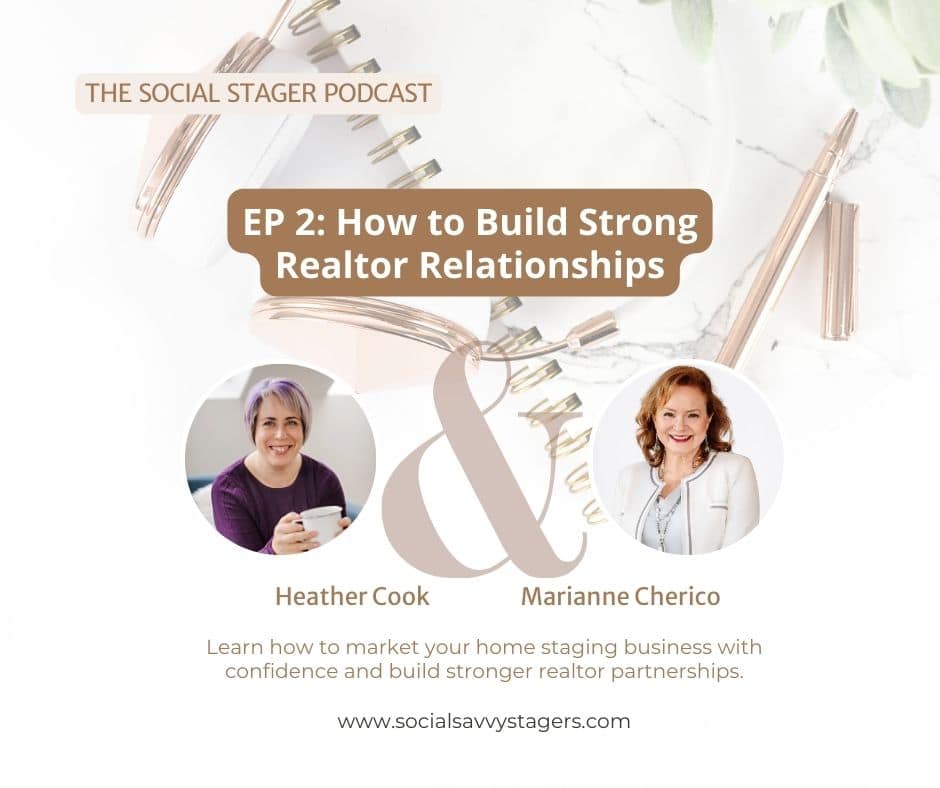
This came up recently in a conversation I had with Marianne Cherico on The Social Stager Podcast. Marianne is a coach who helps home stagers build confidence, own their value, and create strong realtor relationships. She spent 27 years in real estate before starting her staging business in 2005, and now she coaches stagers through the mindset blocks that quietly stop them from showing up. Our conversation made one thing clear: mindset plays a bigger role in getting realtor referrals for home stagers than most people realize.
Why Outreach Feels So Hard (Even When You Know What to Do)
Most stagers assume they need better scripts, more polished pitches, or the right marketing tactics to connect with realtors. They think that if they just had the perfect words or the right approach, outreach would feel easier. But that’s not usually what’s happening.
The reality is that most stagers already know what to do. They’ve read the advice. They’ve seen the strategies. They’re stuck because of how they see themselves.
The real barriers are imposter syndrome, fear of rejection, and feeling like they’re not established enough to be taken seriously. These beliefs don’t always show up loudly. They show up as avoidance. As over-preparing. As waiting until everything feels perfect before taking action.
You research endlessly or rework your website one more time. You tell yourself you’ll reach out once you have more experience, more photos, more proof. But perfect never comes. And meanwhile, you’re not building the relationships that would actually grow your business.
I talk about this often with stagers: you have to see your value before you can sell it. If you don’t see your value or understand what skills or superpowers you bring to the table, it’s really hard to show up with confidence. And that’s not just a mindset issue. It’s a branding issue.
Marianne calls this the home stager mindset trap. She estimates that 80% of the struggle stagers face when building realtor relationships comes from mindset, and only 20% comes from strategy. When you don’t own your value, your energy reflects that. And realtors notice.
The Mindset Shift That Changes How You Show Up
The shift that changes everything is this: stop thinking “I need a job” and start thinking “I help agents win listings and elevate their brand.”
When you approach outreach from a place of needing something, it shows. You sound tentative and apologize for taking up their time. You worry about coming across as desperate or salesy. But when you shift your perspective and see yourself as someone who offers real solutions to problems realtors actually have, the entire conversation changes.
Marianne shared a simple reframe she teaches her coaching clients: “Hi, I’m Marianne Cherico from Interiors by Marianne Cherico. I have a home staging business, and I’d love to talk to you about how I help my preferred agent partners win listings. Would you be interested in setting up a coffee date?”
That language doesn’t sound needy. It doesn’t sound like you’re asking for a favor. It sounds confident, clear, and focused on what’s in it for them. And that shift in how you position yourself changes how realtors respond to you.
But here’s what I want to emphasize: you can’t communicate that kind of confidence if you haven’t done the foundational work of understanding your own value first. That’s why clarity comes before visibility. That’s why brand work matters. Your brand isn’t just your logo or your colors. It’s how you articulate what makes you different, what you consistently deliver, and why that matters to the people you want to work with.
This ties directly into the home stager mindset work Marianne does with her clients. You can’t control how agents respond. You can only control whether you show up. And when you show up believing you have something valuable to offer, that confidence is what makes the difference.
Marianne shared a story from her own staging business that illustrates this. She met with an agent for coffee, and they had what she called a “love fest.” The connection was real. But the agent didn’t hire her. Marianne knew why: there was a stager in the office that everyone used, and stepping outside of that comfort zone felt uncomfortable for the agent.
If Marianne had taken that personally, if she had made it mean something about her value or her business, it would have stopped her momentum. But she didn’t. She let go of the attachment to that one outcome. And two years later, that same agent referred another agent to her. The relationship still mattered, even though the initial answer was no.
That’s the mindset shift. Rejection now doesn’t mean rejection forever. And one agent saying no doesn’t define your value.
In episode 2 of The Social Stager Podcast, Marianne Cherico and I talk openly about the mindset blocks that stop stagers from building realtor relationships—and what actually works. Listen to the full episode here.
What Realtors Actually Care About (And How to Talk About It)
Once you’ve shifted how you see your value, the next step is understanding what realtors actually care about when they’re deciding who to work with.
They don’t care about your certifications or how long you’ve been staging. They care about what’s in it for them.
What moves realtors is simple: winning listings, elevating their brand, making more money, and saving time. If you can help them do those things, they’ll want to work with you. But you have to be able to articulate that clearly.
This is something I emphasize with every stager I work with: your marketing has to speak to your audience, not your ego. When I look at home staging websites, I often see pages that focus entirely on the stager. Their story. Awards they have won. Accolades they are proud of. And while those things have their place, they don’t communicate value to the people you’re trying to reach.
If you’re struggling to connect with realtors, one of the first places to look is your messaging. Are you making it about them? Are you addressing their goals, their pain points, their challenges? Or are you making it about you?

This is where marketing to real estate agents shifts from feeling awkward to feeling strategic. Marianne teaches her coaching clients to position themselves using a framework from Donald Miller’s book “Building a StoryBrand.” You’re not the hero. The realtor is. You’re the guide. You’re Yoda to their Luke Skywalker.
That reframe changes everything about how you show up in conversations. When you meet with an agent, you’re not there to talk about yourself. You’re there to listen, ask questions, and understand their goals. Then, when it feels right, you explain how you help.
From there, you explain the value you bring. You help agents elevate their brand so that, when sellers research agents online, their listings stand out. Your services help them win listings by offering staging consults as a tipping point during listing appointments. As a result, they sell homes faster and for more money, which builds their reputation and fills their pipeline with more referrals.
This is the kind of messaging that makes realtors stop and think: “You get me in a way that others don’t.” And that’s when relationships start to build. When you can articulate your expertise and perspective in a way that directly addresses what realtors care about, you stop blending in. I wrote more about how thought leader content helps you communicate your value and stand out in this article.
Marianne created a free resource called Three Steps to Fully Book Consults with Agent Referrals that walks you through the mindset shifts and actionable steps to start building stronger realtor relationships. Grab it here.
Why Relationship-Building Beats Marketing Tactics
Social media, websites, and email marketing all matter. They support your visibility and help realtors find you. But they don’t replace the power of face-to-face relationships.
The fastest way to build trust with realtors is to meet them in person. Coffee dates. Office presentations. Volunteering at realtor-focused events like the Women’s Council of Realtors or local networking groups. These are the interactions that deepen trust and create the kind of relationships that lead to consistent referrals.
I experienced this firsthand in my own staging business. One of the most powerful marketing strategies I used wasn’t social media. I was giving presentations at real estate offices. Those presentations positioned me as an expert, built credibility, and opened doors to steady referrals. But none of that would have worked if I hadn’t already done the work to understand my value and communicate it clearly.
Marianne’s advice to her coaching clients is direct: 10x what you’re doing. If you reached out to five agents and didn’t hear back, reach out to 20 more. If you reached out to 20 and only one responded, that’s valuable information. It means if you reach out to 100, you’ll likely get five. And those five agents might refer you to others. They might send design work your way. They might become long-term partners.

This is where marketing to real estate agents shifts from tactics to consistency. You can’t control whether one specific agent says yes. But you can control whether you keep showing up.
Marianne also emphasized the importance of letting go of attachment to the outcome. One stager she coached went to an open house to introduce herself to the agent. The agent was busy managing buyers, so the stager respectfully left a brochure and didn’t push for a conversation. Later, when the agent had more time, they connected, and the agent was warm and interested.
But if that stager had made up a story in her head about the agent being dismissive or uninterested, she might not have followed up. She might have let that one moment stop her. Instead, she read the room, respected the agent’s time, and stayed open to the relationship developing later.
That’s the mindset that builds realtor referrals for home stagers. You focus on what you can control: your consistency, your professionalism, and your willingness to show up even when you feel unsure.
Small wins matter. You called even though you were scared. You showed up at the networking event and sent the follow-up email. Those are the real successes, not just whether an agent said yes immediately. I talk more about how presentations position you as an expert and open doors to referrals in this article.
How to Start Taking Action (Even When You Feel Unsure)
You don’t need to feel 100% confident to start building relationships with realtors. You build confidence by showing up, not by waiting until you feel ready.
But here’s what I want to be clear about: showing up without clarity is just noise. Before you start reaching out, make sure you’ve done the foundational work. Understand your ideal client. Know what problems you solve. Be able to articulate what makes you different and why that matters.
If you’re not sure how to talk about your value, if your messaging feels generic, or if you’re still trying to figure out what sets you apart, that’s where you need to start. Because outreach without positioning is just an activity. It’s not a strategy.
Here are a few simple starting points once that foundation is in place:
Reach out to one agent this week and ask them to coffee. Keep it simple. Let them know you’d love to learn more about their business and share how you help agents win listings.
Volunteer at realtor-focused events. The Women’s Council of Realtors, local real estate board meetings, and other networking groups are full of agents. Show up. Get to know them. Let the relationships develop naturally.

Follow up with agents you’ve already met. Maybe you connected at an event six months ago. Maybe an agent didn’t hire you for a listing last year. Reach out again. Relationships take time, and one “no” doesn’t mean the door is closed forever.
Use your website and social media to support face-to-face outreach, not replace it. Realtors will look you up online. Make sure your digital presence reflects your value and speaks to what they care about. But don’t let posting on social media become a substitute for actually reaching out.
Reframe rejection. A “no” now doesn’t mean “no” forever. It might mean “not the right timing” or “I’m already working with someone else.” It doesn’t mean you’re not good enough or that your services aren’t valuable. Let go of the story you’re making up in your head and keep moving forward.
Focus on what you can control: your consistency, your messaging, and your mindset.
Where to Get Support
Realtor referrals for home stagers start when you own your value and show up with confidence. The mindset work isn’t soft. It’s foundational. Without it, even the best marketing strategies will feel harder than they need to.
But mindset alone isn’t enough. You also need clarity on what makes you different, how to articulate that value, and how to position yourself so realtors see you as the obvious choice. That’s the branding work. That’s the positioning work. And it matters just as much as the mindset work.
If outreach has been holding you back, this is your reminder: you have more to offer than you think. And the agents in your market need what you bring. But they can’t see your value if you haven’t clarified it for yourself first.
Here are the resources mentioned in this article:
Listen to the full podcast episode with Marianne here.
Download Marianne’s free resource: Three Steps to Fully Book Consults with Agent Referrals.
Follow Marianne’s podcast: Home Stagers and Designers on Fire.
Learn more about coaching with Marianne.
If marketing your staging business feels overwhelming, The Social Stager Club gives you the content plans, templates, and support to show up consistently without the stress. Learn more here.